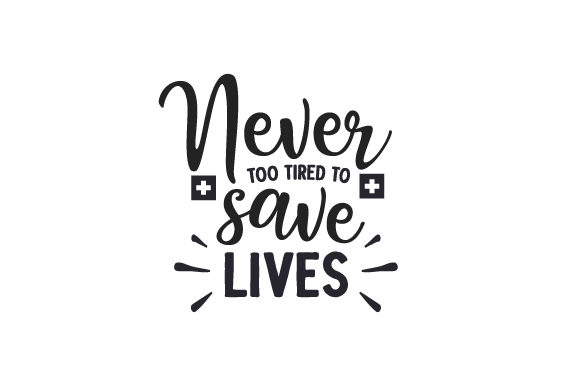
Never Too Tired to Save Lives
A Design That Breathes Respect—Not Just Resilience
First glance at Never Too Tired to Save Lives isn’t about bold fonts or flashy graphics—it’s about quiet gravity. The phrase lands with soft weight: no exclamation marks, no medical icons crowding the message, no forced urgency. It’s clean, centered, and deeply human. As a designer who’s stitched hundreds of phrases for nurses, EMTs, lab techs, and hospital volunteers, I appreciate how this avoids cliché while still speaking volumes. It doesn’t shout “hero”—it whispers “I showed up, again.” That tone translates beautifully into embroidery: legible at 3 inches, dignified at 6, and emotionally resonant whether stitched on a scrubs pocket or a baby blanket gifted to a resident’s family.
Where This Design Earns Its Keep—in Real Projects
Last week, I prepped a custom embroidered tote bag for a local clinic’s volunteer appreciation day. The bag was natural canvas—medium weight, slight texture—and I chose Never Too Tired to Save Lives as the centerpiece. Why? Because it didn’t need embellishment. A single-line satin stitch outline around the text gave subtle structure without heaviness. On the tote, it read clearly from six feet away but didn’t overwhelm the fabric’s organic feel. Customers paused. Smiled. Touched the stitching. That’s the signal: this design carries emotional resonance—not just decoration.
I’ve also tested it on sweatshirt embroidery (midweight fleece), baby embroidery (cotton interlock onesies), and embroidered patch blanks (woven twill). Each time, the phrase held its shape. No letter collapse. No thread nesting in the “e” or “o” curves. The spacing between words is generous enough for fill stitch breathing room, yet tight enough to feel intentional—not loose or accidental. For Etsy sellers listing personalized gifts, that balance means fewer revision requests and higher perceived value. For craft business owners building boutique branding, it reads like part of a thoughtful collection—not a stock phrase dropped in.
Use With Care: Where Context Changes Everything
This isn’t a one-size-fits-all machine embroidery design. Its strength lies in restraint—but that same restraint becomes a limitation in certain scenarios.
- Small hoop sizes (under 4”): The full phrase loses clarity below 3.5”. Consider using just “Save Lives” if you’re stitching a cap visor or narrow apron pocket.
- Textured or stretchy fabric: On terry cloth towels or jersey knit tees, use medium-cutaway stabilizer and reduce top tension slightly. The clean lines demand stability—especially through the lowercase “g” and “y” descenders.
- Dark fabric: Test thread colors before committing. A soft heather gray or charcoal works better than stark black on navy or black apparel—it preserves the phrase’s warmth without visual fatigue.
- Curved surfaces: Caps and curved pillow covers require re-hooping mid-stitch or digitized contour adjustments. The original file has no built-in curve compensation, so treat it as a flat-layout embroidery file unless your software handles automatic wrap.
What It Adds—Beyond Thread and Fabric
Never Too Tired to Save Lives quietly elevates handmade product perception. Unlike busy clip-art-style medical motifs, it invites pause—not just recognition. That matters for holiday embroidery (think: embroidered tea towels for nurse friends), wedding gifts (a linen pillow cover for a med-school grad), or nursery decor (a gentle reminder stitched into a cotton swaddle). Buyers don’t just see text—they see intention. That builds customer trust, especially for small shop products where authenticity is currency.
For commercial embroidery projects, it scales well across formats: as a standalone chest logo, a sleeve accent, or even split across two lines on a kitchen towel hem. And because it’s offered in SVG, Transparent PNG, EPS, and DXF, it’s flexible for hybrid workflows—like pairing the vector outline with an applique design or layering it into a printable mockup for Etsy listings.
Designer Notes You’ll Actually Use
Before stitching your first Never Too Tired to Save Lives finished product:
- Test the embroidery file on scrap fabric matching your final project’s weight and stretch.
- Check thread color contrast in both natural and artificial light—some blends shift dramatically.
- Review stitch density visually: dense fill areas (like solid caps) should be under 18,000 stitches for home machines.
- Confirm hoop size compatibility—this design fits comfortably in a 5x7 hoop, but verify if your version includes alternate sizing.
- Inspect small details at 200% zoom: are all letter terminals clean? Does the “t” crossbar sit evenly?
- Test it in black-and-white mockups—this phrase relies on readability, not color pop.
- Compare performance on light vs. dark fabric backgrounds. Some thread brands mute differently on deep tones.
- Use tear-away + cut-away stabilizer combo for structured items like tote bags; only tear-away for baby embroidery.
- Verify licensing terms before selling finished items or digital embroidery files—this Medical category Crafts design may have usage restrictions for resale.
Fitting In—Without Fading Out
In a market flooded with generic “Nurse Life” slogans and cartoonish stethoscope graphics, Never Too Tired to Save Lives stands apart by refusing to simplify. It doesn’t reduce caregiving to a meme—it honors its weight. That makes it ideal for creative entrepreneurs who sell more than objects: they sell meaning. Whether you’re an apparel decorator stitching custom scrubs, a hobbyist making holiday embroidery for ER staff, or an Etsy seller curating heartfelt craft business collections, this design earns its place—not because it’s trendy, but because it’s true.
It won’t dazzle with complexity. It won’t beg for attention. But when someone sees it on a worn apron or a folded blanket, they’ll understand—not just the words, but the hands that stitched them, and the hearts they represent.